
Share This On


Next Generation Memory Market – Size, Outlook, Trends and Forecast (2024 – 2032)
Report ID
#5492
Report Type
Global
Study Period
2018 - 2035
Base Year
2025
Expected CAGR
7%
Next-generation memory provides the opportunity to meet consumer expectations like higher performance and much less standby power on mobile devices and true instant-on for laptops. Next-Generation memory is a competitive weapon for mobile devices. Advancements in technology such as the Internet of Things (IoT), artificial intelligence, and big data is growing the demand for highly accessible memory devices which are compatible with these technologies.
Global Next Generation Memory Market Size & Growth:
Global, Next Generation Memory Market size, is projected to reach 9.71 Billion by the end of 2024 with a CAGR of 26.59% during the forecast period. Key Parameters promoting the market growth include increasing demand for enterprise storage application, big data demand for universal memory devices, need for low power consumption, high bandwidth, and highly scalable memory device for technologies such as artificial intelligence, big data, and internet of things, decreasing profit margins for traditional memory technologies, growing demand for mass storage and universal storage, increasing demand in various applications such as industrial and replacement of flash memory, and increasing demand for flexible and wearable electronics.
Replacing these regular memory chips with MRAM is witnessed to increase the battery life of equipment and also it is expected to overlay the way for smaller battery components boosting the development of wearable devices such as eyeglasses and watch computers. High designing cost and stability in extreme environmental conditions are the major restraints which hinder the market growth.
Global Next Generation Memory Market Share:
Global Next Generation Memory Market is classified by Technology, by Wafer Size, by Application, by End-User, by geography. By Technology, the Global Next Generation Memory Market is classified as Non-Volatile memory and volatile memory. Non-Volatile is further classified into magneto-resistive RAM, FRAM, Resistive RAM, 3D Xpoint, Nano-RAM. Volatile Memory is further classified as hybrid memory cube and high-bandwidth memory. Among these, Non-Volatile holds the largest market share during the forecast period 2018-2024. In Non-Volatile, magneto-resistive RAM segment holds the largest market share due to its improved performance, lower power consumption, better scalability with extremely high write endurance. The non-volatile memory includes phase-change memory, magneto-resistive RAM, flash and spin-transfer torque RAM, ferroelectric RAM, resistive RAM. Among these, RRAM, MRAM, and STT-RAM are witnessed to be promising emerging technology. By Wafer Size, these are classified as non-volatile memory market by wafer size, volatile memory market by wafer size which includes 200mm, 300mm, and 450mm. 450mm wafer is expected to have the highest CAGR during the forecast period 2018-2024 due to the increasing cost and feature dimension. 450mm wafer would be the preferred choice for the next generation memory technologies. By Application, these are classified as cache memory, smart cards, embedded MCU, and mobile phones. By End-User these are classified as consumer electronics, government, and BFSI. Consumer Electronics is expected to have the highest CAGR during the forecast period. With the growing consumer electronics market, the demand for emerging memory technologies is witnessed to increase.
Next Generation Memory Market
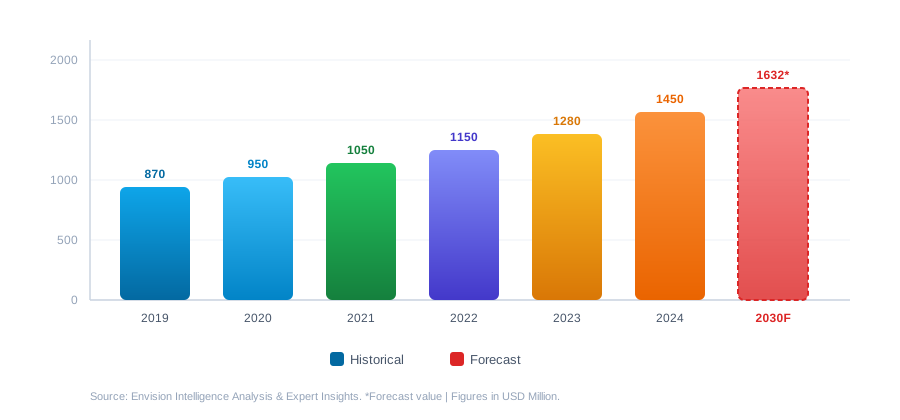
Expected CAGR
~7.6%
2026-2035
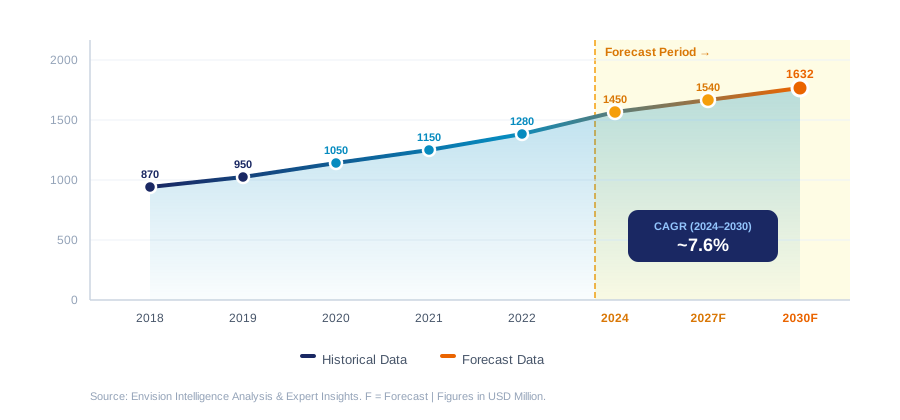
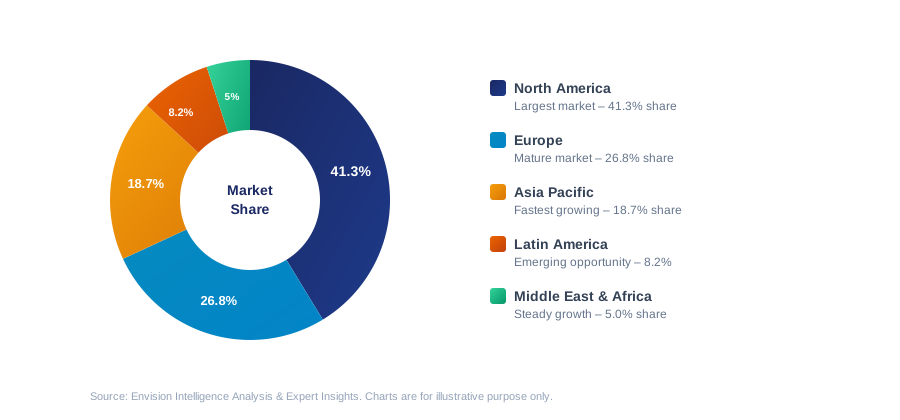
Asia-Pacific is dominating the market and is expected to have the highest growth rate during the forecast period 2018-2014 owing to growing number of data centres and servers, increasing number of manufacturing activities in the enterprise storage and consumer electronics sectors, and increasing shipments of network equipment.
Global Next Generation Memory Market Trends:
Global Next Generation Memory Market Research Reports:
An executive summary condensing the whole report such that essential authority can rapidly twist up doubtlessly acquainted with brief overview and conclusion.
To have complete market analysis through industry value chain analysis, Porter’s five, PESTLE, SWOT analysis, and Y-o-Y analysis.
Regional and global is analysed with the major countries and the unions. Scrutinizing the revenue generation on Year–On–Year
Next Generation Memory Market
Identifying DROC in the current market and their impact in altering the market dynamics.
Competitive landscape analysis to identify the merger and acquisition which will have a comparative financial analysis with major competitors.
Expertise investment opportunities by an analyst to the individual and organisation to have a better foothold in the market.
Identify the latest developments, market shares and strategies that are employed by the major market players, such as
Along with these companies, there were many other companies considered/cited in the report while analysing the Global Next Generation Memory market. These companies hold substantial share-owning to the nature of the industry whereas rest of the market shares are marginal chunks to regional and local level manufacturers. Other players have considerable presence owing to its robust brand image, geographical reach and strong customer base.
Next Generation Memory Market
Market Size Available | 2018 - 2035 |
Base Year | 2025 |
Forecast Period | 2026-2035 |
Historical Period | 2018-2025 |
Segments Analysed | By Type, Application, and Region |
Analyses Covered | Global, Regional & Country Level; Segment Analysis; Drivers, Restraints, Opportunities, Challenges; PESTLE; Porter's Five Forces; Competitive Landscape |
Regions Covered | North America · Europe · Asia Pacific · Latin America · Middle East & Africa |
Report Formats | Extensive Report (350 pages) | Snapshot Report (85 pages) |








Starting from $2700

Starting from $2160

Starting from $2700
Keep up-to-date with our weekly newsletter, Media Pulse.

Data-driven market insights & solutions


