
Share This On


Global Virtual Retinal Display Market – Size, Outlook, Trends and Forecast (2024 – 2032)
Report ID
#5555
Report Type
Global
Study Period
2018 - 2035
Base Year
2025
Expected CAGR
7%
Virtual Retinal Display is a breakthrough in imaging technology that will optimally couple human vision to the computer. Virtual retinal displays produce very high-resolution images, and brightness can be augmented to high levels or lowered to lower more minimal levels. VRD consists of a light source, light modulation, horizontal scanner, vertical scanner, and imaging optics.
Global Virtual Retinal Display Market Size & Growth:
Global Virtual Retinal Display Market size is projected to reach 66.7 Billion by the end of 2024 with a CAGR of 45.32% during the forecast period. Key Parameters promoting the market growth include advancements of this technology, need for low-cost, high-resolution display solutions, the necessity of virtual environments and augmented visions, demand of higher resolution, higher contrast, increased luminance and bright images, the growth of virtual reality and augmented reality applications across multiple industries. Video Electronics, light sources and modulators, and scanners are the major components present in the virtual retinal display.
The combination of high contrast, high brightness, and high resolution make the VRD ideal and then it can be used in the surgical display. Future systems will be even more compact with the advent of Micro Electro Mechanical System Scanners(MEMS), miniature laser diodes, and application-specific IC technology. The key development for virtual retinal display is the advent of augmented reality display systems to assist people in their various tasks.
Global Virtual Retinal Display Market Share:
Global Virtual Retinal Display Market is classified by Components, by Application, by End-User, by geography. By components, the Global Virtual Retinal Display Market is classified as video electronics, light source and modulator, scanners, pupil expander, viewer optics, and holographic optical element. By Application, these are classified as aviation & tactical, engineering, medical, gaming & entertainment, sorts, and training & simulation. Among this, gaming entertainment is expected to have the largest market share during the forecast period owing to demand created for augmented reality and virtual reality applications by users. Sports segment is expected to have the highest CAGR during the forecast period because of the clarity and detail possible in VRDs while watching sports events. By End-User, these are classified as Aerospace & Military. The main key features of the virtual retinal display are size and weight, power consumption, resolution, brightness, the field of view, a stereoscopic display, and inclusive and see through. In the Virtual retinal display, when an image is perceived, rays of light from the object seen pass through the cornea, aqueous humour, vitreous body to stimulate the nerve endings in the retina. The stimuli received by the retina pass along the optic tracts to the visual areas of the brain to be interpreted. Both areas receive the message from both eyes; then it will give perspective and contour.
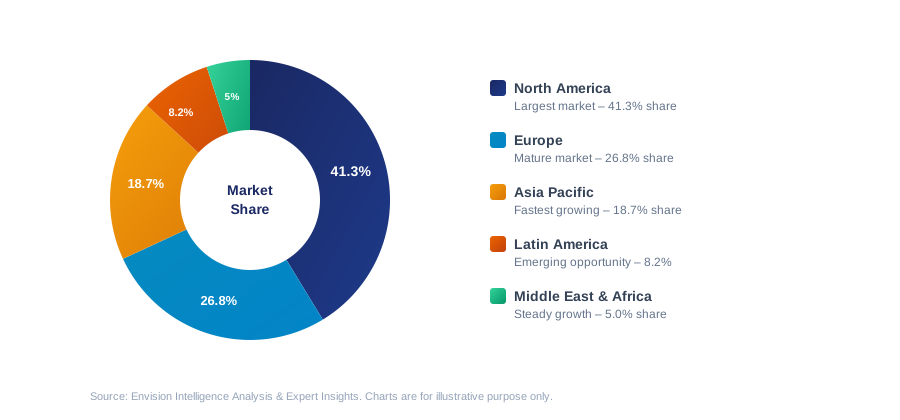
North America is expected to dominate the virtual retinal display market over the next five years. In North America, US is the leading country in the region and expected to continue to be a leading technology provider due to the presence of companies like Microvision and Avegant.
Asia-Pacific is expected to have the highest market regarding mass production of AR devices like HMDs, mobile devices, and smart glasses. The VR gaming market in Asia is expected to grow at a high rate during the forecast period 2018-2024.
Global Virtual Retinal Display Market
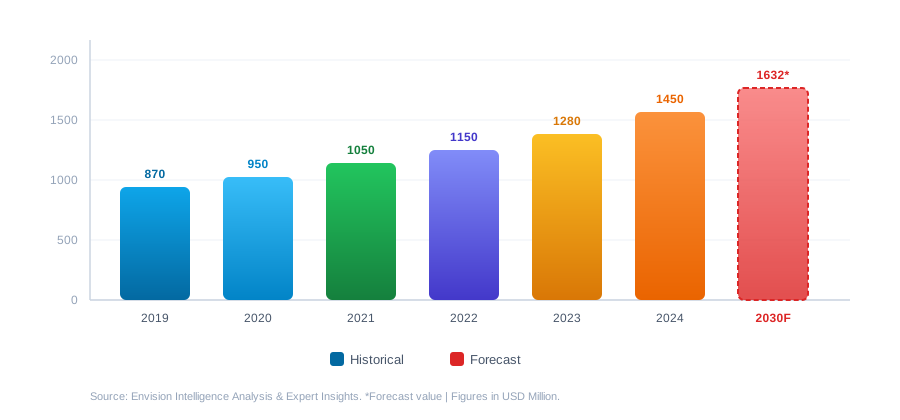
Expected CAGR
~7.6%
2026-2035
Europe is expected to have the market during the forecast period 2018-2024. In Europe, Germany, France are leading countries. BMW and Volkswagen and many publishing companies have employed AR technology and created huge interest among consumers which leads to the adoption of VRD technology.
The Middle East and Africa are not having much impact on VRD devices and technology and in Israel several companies involved in the defence, military, and aerospace where VRD can be effectively used.
Global Virtual Retinal Display Market Trends:
Global Virtual Retinal Display Market Research Reports:
An executive summary condensing the whole report such that essential authority can rapidly twist up doubtlessly acquainted with brief overview and conclusion.
To have complete market analysis through industry value chain analysis, Porter’s five, PESTLE, SWOT analysis, and Y-o-Y analysis.
Regional and global is analysed with the major countries and the unions. Scrutinizing the revenue generation on Year–On–Year
Global Virtual Retinal Display Market
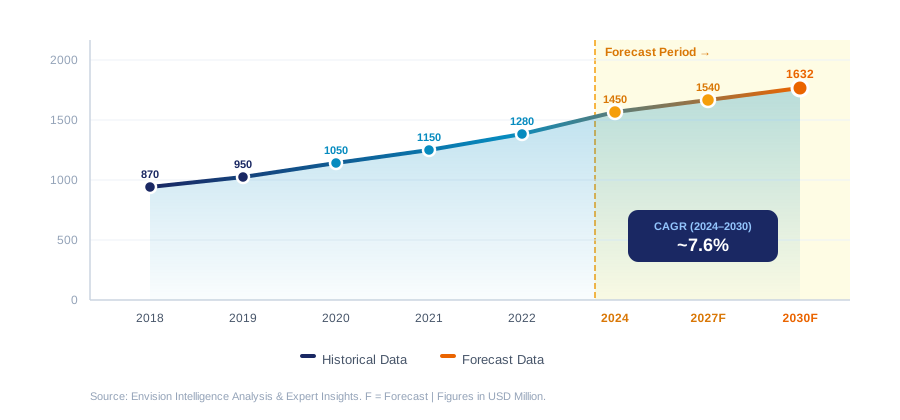
Identifying DROC in the current market and their impact in altering the market dynamics.
Competitive landscape analysis to identify the merger and acquisition which will have a comparative financial analysis with major competitors.
Expertise investment opportunities by an analyst to the individual and organisation to have a better foothold in the market.
Identify the latest developments, market shares and strategies that are employed by the major market players, such as
Along with these companies, there were many other companies considered/cited in the report while analysing the Global Virtual Retinal Display market. These companies hold substantial share-owning to the nature of the industry whereas rest of the market shares are marginal chunks to regional and local level manufacturers. Other players have considerable presence owing to its robust brand image, geographical reach and strong customer base.
Global Virtual Retinal Display Market
Market Size Available | 2018 - 2035 |
Base Year | 2025 |
Forecast Period | 2026-2035 |
Historical Period | 2018-2025 |
Segments Analysed | By Type, Application, and Region |
Analyses Covered | Global, Regional & Country Level; Segment Analysis; Drivers, Restraints, Opportunities, Challenges; PESTLE; Porter's Five Forces; Competitive Landscape |
Regions Covered | North America · Europe · Asia Pacific · Latin America · Middle East & Africa |
Report Formats | Extensive Report (350 pages) | Snapshot Report (85 pages) |








Starting from $2700

Starting from $2160

Starting from $2700
Keep up-to-date with our weekly newsletter, Media Pulse.

Data-driven market insights & solutions


